Methodology
This site began as a 'what if' joke between two lovers ex-lovers friends, but quickly turned into a rather more rigorous endeavour. We accepted the challenge of making the site a reality, and did what we knew we had to do: hire an intern with a crazy amount of skeletons in the closet (see: leverage) to do the dirty work.
First, we had to define the dataset.
Dataset Overview
| Quick Facts | |
|---|---|
| Films | 250 |
| Actors | 9577 |
| Watchtime | 22 days, 11hrs |
| Beige Score Distributions | |
|---|---|
| Creamy | 60.8% |
| Beige Fever | 30% |
| Middlebeige | 3.2% |
| Down to Brown | 2.8% |
| Welcome to Beigewatch | 3.2% |
The IMDb Top 250
We decided to hitch our wagon to IMDb's Top 250 User Rated films. This list, according to the movie-watching, IMDb-voting public, represents the best cinematic touchstones from the 1920s to the 2020s. Even if you hate watching movies, like Alan (The Beige Index Intern), chances are you're familiar with a great many of these titles. By and large, they're the films future generations are destined to remember fifty years from now, in the coming utopia (dystopia if you're racist) when every film will have a minimum beige-o-meter score of BEIGE FEVER.
Credited Cast Only
To keep things feasible and replicable, only credited actors were included in our dataset. Extras, even if they had lines, were not included. When in doubt, we trusted the IMDb credited cast list.
Taxonomy of Ethnic Groups
Oh no! What a terrible header.
Anyway. We had no choice. No choice! The people wanted, nay, needed this. So yeah, Alan designed a taxonomy of ethnic groups.
| Grouping | Inclusions |
|---|---|
| White | Anglo-Saxon, Southern, Central and Eastern European, Celtic, the Caucasus, Gallic and Semitic descent |
| North Asian | Mongolian descent |
| East Asian | Chinese, Japanese and Korean descent |
| Southeast Asian | Indochinese, Malaysian, Thailand, Vietnamese, Indonesian, Filipino and Singaporean descent |
| Latin American | Mexican, Guatemalan, Honduran, El Salvadorian, Nicaraguan, Costa Rican, Panamanian, Colombian, Venezuelan, Ecuadorian, Peruvian, Bolivian, Brazilian, Paraguayan, Chilean, Argentinean, Uruguayan, Cuban, Haitian, Dominican and Puerto Rican descent |
| Native American | First Nations groups from the Americas such as the Algonquin, Iroquois, Huron, Wampanoag, Mohican, Mohegan, Ojibwa, Ho-chunk, Sauk, Fox and Illinois |
| Pacific Islander | Native Hawaiian, Samoan, Gumanian or Chamorro, Fijian, Tongan, Marshallese, Melanesian, Micronesian and Polynesian descent |
| Middle Eastern | Arab, Kurd, Persian, Turk, Azerbaijan, Aramean, Assyrian, Armenian, Bahrani, Baloch, Copts, Druze, Gilaks, Laz, Lurs, Mandaean, Maronite, Mazanderani, Mhallami, Nawar, Rûm, Samaritan, Shabak, Talysh, Tat and Zaza descent |
| South Asian | Bangladeshi, Bhutanese, Indian, Maldivean, Nepalese, Pakistani and Sri Lankan descent |
| Indigenous Australian | First Nations groups including, but not limited to, the Anangu, Goorie, Koorie, Murri, Nunga, Noongar, Palawan, Tiwi |
| Black | Nigerian, Ethiopian, Egyptian, Congolese, South African, Tanzanian, Kenyan, Ugandan, Algerian, Sudanese, Moroccan, Angolese, Ghanian, Mozambican, Madagascan, Cameroonian, Côte d'Ivoirian, Nigerian, Burkinanabe, Malian, Malawian, Zambian, Senegalese, Chadian, Somalian, Zimbabwean, Guinean, Rwandan, Beninese, Tunisian, Aburundi, South Sudanese, Togolese, Sierra Leonian, Libyan, Congolese, Liberian, Central African, Mauritanian, Eritrean, Namibian, Gambian, Botswanan, Gabonese, Basotho, Bissau-Guinean, Equatoguinean, Mauritian, Emaswati, Djiboutian, Réunionese, Comorian, Western Saharan, Cabo Verdean, Maorais, Santomean, Seychellois and Saint Helenian descent |
Oh sure, it looks easy in table form. But consider the brief existential crisis we were forced to have about Italian, Greek, Spanish, Jewish, Egyptian and other ethnicities, until we decided to focus on things we could control, like our own mental health.
Actor Research
We performed tiered research to determine and record each actor's ethnicity.
| Tier | Inclusions |
|---|---|
| 1 |
|
| 2 |
|
While many actors had a Tier 1 item available, a large number did not. In the absence of Tier 1 information, two or more Tier 2 items were used to verify ethnicity.
Two other metadata tags were introduced to account for actors for which no conclusive verification could be determined:
- Unverifiable: Most often assigned to actors for which no or insufficient publicly available biographical information existed, and insufficient information existed to visually validate identity within the film. These actors were not included in the database.
- Indeterminately beige: Most often assigned to actors who were able to be visually identified within the film but for which no or insufficient publicly available biographical information existed and, in combination with any other tier 2 criteria, whom our assessor, Alan, was nonetheless satisfied were non-White.
If biographical information was available indicating an actor was of two or more ethnicities, each ethnicity was included in the metadata tagging with equal weight.
Numerical Beigeness
Remember earlier, when we said that Italians give us a headache? You know, on account of the whole are-they-white thing. Well thank God they made it up to us.
Enter Renato Biasutti, the esteemed Italian geographer who used the von Luschan Scale—at the time of his work, a set of 36 tinted glass dowels—to classify the skintones of all humans. Arrogant stuff, really. His dataset was the world. All we covered was 10,000 actors.
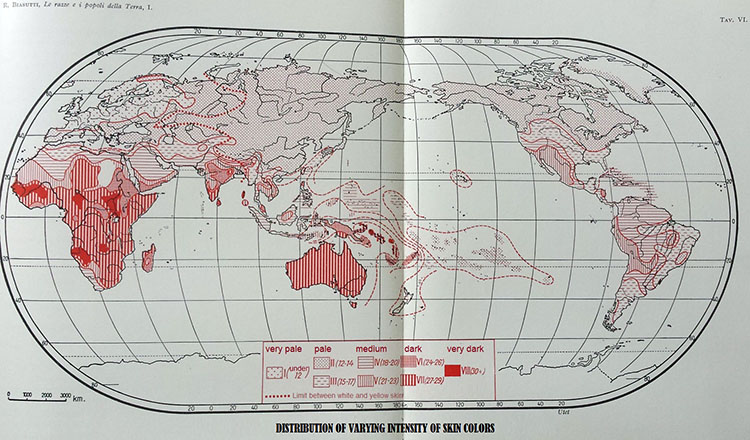
Interestingly enough, while this system of classification sounds relatively crude, and isn't perfect, the von Luschan Scale is still used by dermatologists today as a proxy for spectrophotometry. And a 2014 study in the Indian Journal of Dermatology showed that this proxy is effective in a clinical setting. We're not completely full of crap, is what we're saying.
Here is our table of numerical beigeness taxonomy to numerical score, derived from the work of Biasutti and von Luschan:
| Grouping | Score |
|---|---|
| White | 12 |
| North Asian | 14 |
| East Asian | 15 |
| Indeterminately beige | 18 |
| Latin American | 20 |
| Native American | 20 |
| Southeast Asian | 20 |
| Middle Eastern | 22 |
| Pacific Islander | 22 |
| South Asian | 24 |
| Indigenous Australian | 28 |
| Black | 30 |
You'll see that the numbers are selected from within their ranges as laid out by Biasutti, though not always consistently. You'll note that White sits at the end of its range, while Black sits in the middle. Why is this? Because—
The Beige Score is Just an Average
Yep. There are no complicated algorithms here. The most complicated equation in the whole project is used by the backend to calculate the angle on the Beige-o-Meter™.
Using an average, though, meant we needed to adjust the final numbers in order to ensure that any given value didn't affect the final score too much. For instance: set the White score to the Biasutti/von Luschan midpoint of 6, and almost every film becomes Creamy. Set the Black score to 36, and the IMDb Top 250 looks a lot more beige than it actually is. The final numbers were chosen to visually reflect the dataset as accurately as possible.
We are of course aware that more complex models are possible for this sort of data. An ideal version of The Beige Index would calculate a beige score per frame, and then average that out across a whole film. We managed to get Alan to do this for a single film, Once Upon a Time in America, and he came as close to escaping quitting as he ever has. Someday, there may be the potential to use Google's Monk Skin Tone scale combined with machine-driven frame analysis to calculate an extremely accurate Beige Score for every film in history (or at least all the ones available on Google Play). But that is out of our scope, for now.
Weighting cast members by billing sounds attractive as a middle ground between our approach and the above hypothetical, until you realise that billing is as much tied to marketing more as it is to screentime—a recent example of this being Zendaya's appearance in Dune for seven of a total 155 minutes, despite her position on the cast list. As such, we have made do with an equally-weighted credited-cast average. And you will make do too, because—
We Watched Every Film
Did we mention this? We mentioned this, right? We watched the films. Yes, all of them. Our wallets are still hurting from the process, but arguably we're better, more well-rounded people as a result. Arguably, we said!
As we continue to update the dataset, we will continue to watch and research the new additions, and mourn old titles from the Top 250 that no longer make the cut.
If you have any questions or complaints about the above methodology, do feel free to reach out directly to Alan at resetpassword@thebeigeindex.com.